
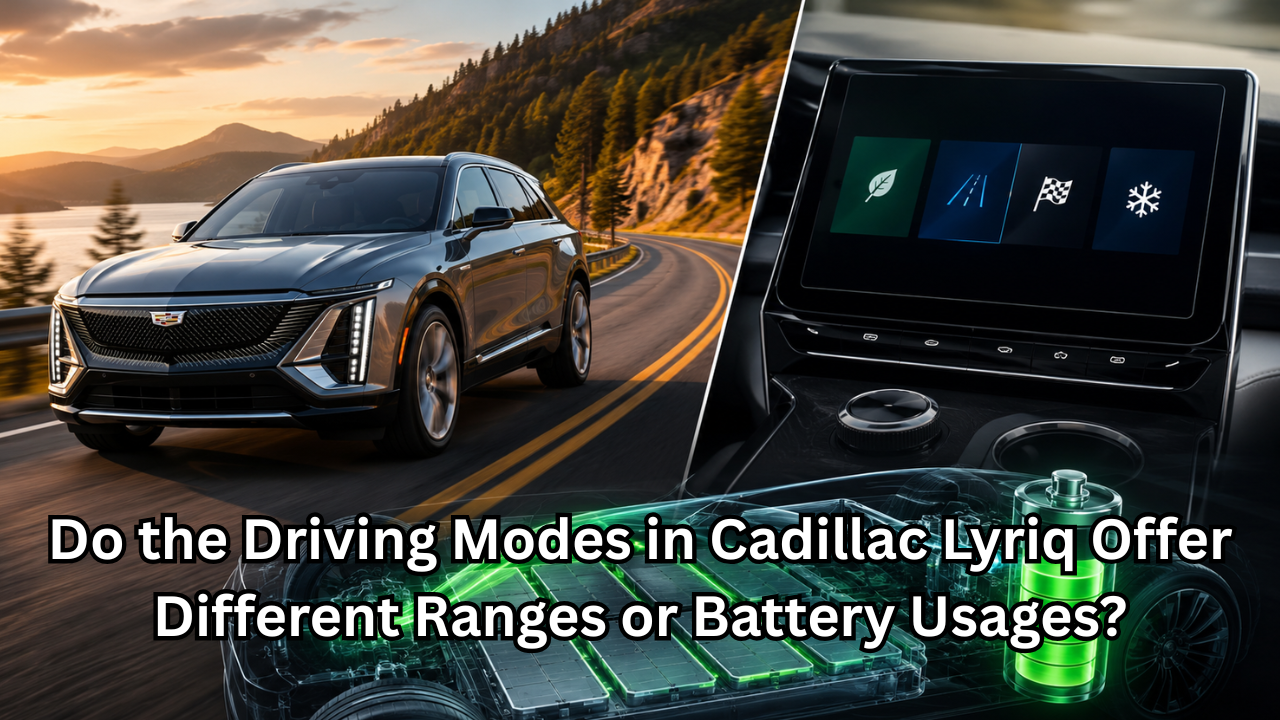
If you’ve recently purchased an electric SUV or you’re considering one, you may have asked yourself, do the driving modes in the Cadillac Lyriq offer different ranges or battery usage? The short answer is yes—but the difference depends on how you drive, the road conditions, and which driving mode you choose.
Built on General Motors’ Ultium battery platform, it combines premium comfort with intelligent energy management. While many drivers focus on charging speed and total range, understanding how the vehicle’s driving modes affect efficiency can help you get even more miles from every charge.
In this comprehensive guide, we’ll explore how Cadillac Lyriq driving modes work, whether they impact battery consumption, and practical tips to maximize your driving range without sacrificing comfort or performance.
Understanding Driving Modes in the Cadillac Lyriq
Modern electric vehicles do much more than simply accelerate and brake. The Cadillac Lyriq offers selectable driving modes that adjust multiple vehicle systems simultaneously.
These modes can influence:
- Accelerator pedal sensitivity
- Steering responsiveness
- Motor power delivery
- Regenerative braking behavior
- Traction and stability settings
- Overall energy efficiency
Instead of changing the battery itself, driving modes modify how efficiently the electric motors use available energy.
Do the Driving Modes in the Cadillac Lyriq Offer Different Ranges or Battery Usages?
Yes. Different driving modes can result in different energy consumption, although the difference is usually moderate rather than dramatic.
A more efficiency-focused mode encourages smoother acceleration and conservative power delivery, helping reduce electricity usage during everyday driving.
Performance-oriented modes provide quicker acceleration and stronger throttle response. While this makes the vehicle feel more responsive, it generally increases battery consumption because the motors draw more power during acceleration.
The actual impact varies based on driving style. A careful driver using a sport-oriented mode may still achieve excellent efficiency, while an aggressive driver in a normal mode could consume significantly more energy.
How Electric Vehicle Efficiency Really Works
Cadillac Lyriq However, battery usage still depends on several factors, including:
- Speed
- Acceleration habits
- Outside temperature
- Tire pressure
- Road incline
- Passenger and cargo weight
- Climate control usage
- Driving mode selection
Driving modes simply influence several of these variables by changing how the vehicle responds to driver inputs.
Normal Mode: The Everyday Balance
For most owners, Normal mode provides the ideal balance between comfort, responsiveness, and efficiency.
In this setting, the Cadillac Lyriq delivers:
- Smooth acceleration
- Comfortable steering feel
- Balanced energy usage
- Predictable driving characteristics
Normal mode is suitable for commuting, city driving, suburban roads, and highway travel.
For many drivers, this mode will deliver the manufacturer’s expected range under average conditions.
Sport Mode: Performance with Higher Energy Consumption
Typical characteristics include:
- Faster throttle response
- Increased motor output
- Sharper steering feel
- More immediate acceleration
Although Sport mode enhances performance, it generally uses more battery power because rapid acceleration requires higher energy output from the electric motors.
Frequent hard acceleration is one of the biggest factors that reduce EV range, regardless of the vehicle.
Snow or Low-Traction Modes
When driving on slippery roads, in winter conditions, or on wet surfaces, dedicated traction-focused modes become valuable.
These modes typically:
- Reduce wheel spin
- Smooth power delivery
- Improve traction
- Enhance vehicle stability
Interestingly, smoother acceleration may slightly improve efficiency under certain conditions, although the primary purpose is safety rather than maximizing range.
Regenerative Braking and Battery Efficiency
One of the most important technologies in the Cadillac Lyriq is regenerative braking.
Instead of wasting energy as heat during braking, the electric motors convert some of the vehicle’s kinetic energy back into electricity.
Benefits include:
- Increased efficiency
- Reduced brake wear
- Improved city-driving range
- Better energy recovery
Drivers who learn to anticipate traffic and maximize regenerative braking often achieve noticeably better efficiency than drivers who rely heavily on conventional braking.
One-Pedal Driving and Energy Savings
The Cadillac Lyriq supports one-pedal driving, allowing the vehicle to slow significantly when the accelerator is released.
This system:
- Increases regenerative braking opportunities
- Reduces unnecessary energy loss
- Makes stop-and-go driving more efficient
- Can improve the urban driving range
Many experienced EV owners report that mastering one-pedal driving helps them consistently achieve better battery efficiency.
Highway Driving vs City Driving
Many people assume highway driving is always more efficient.
For electric vehicles, that’s not always true.
City driving offers more opportunities for regenerative braking, while sustained highway speeds create increased aerodynamic resistance.
Driving at 75 mph typically consumes considerably more energy than cruising at 60 mph.
Therefore, even when using the same driving mode, your overall range may differ significantly depending on where you drive.
Climate Control Also Affects Battery Usage
Heating and air conditioning can noticeably impact electric vehicle range.
During extremely cold weather:
- Battery efficiency decreases
- Cabin heating requires additional energy
- Charging speeds may temporarily slow
During very hot weather:
- Air conditioning consumes battery power
- Battery cooling systems may activate
Using preconditioning while the vehicle is plugged in can reduce these effects and help preserve driving range.
Driving Style Matters More Than Driving Mode
Although many drivers wonder whether driving modes affect battery usage, personal driving habits often have an even greater impact.
Gentle acceleration, maintaining consistent speeds, and anticipating traffic can significantly improve efficiency.
Conversely, repeated rapid acceleration, aggressive overtaking, and high-speed driving can reduce range substantially regardless of the selected mode.
In many cases, driving behavior influences battery consumption more than switching between Normal and Sport modes.
Tire Pressure and Rolling Resistance
Maintaining proper tire pressure is another overlooked factor.
Underinflated tires increase rolling resistance, forcing the electric motors to work harder.
Regularly checking tire pressure can:
- Improve efficiency
- Extend tire life
- Enhance handling
- Increase overall driving range
This simple maintenance step benefits every driving mode equally.
Terrain and Elevation Changes
Driving uphill naturally requires more energy.
Fortunately, electric vehicles recover some of that energy while descending through regenerative braking.
Mountain driving, therefore, produces fluctuating battery consumption rather than constant energy loss.
Drivers should expect lower efficiency during long climbs but partial recovery on downhill sections.
Can Software Updates Improve Efficiency?
Modern electric vehicles frequently receive software improvements.
These updates may optimize:
- Battery management
- Thermal systems
- Regenerative braking calibration
- Energy distribution
- Motor efficiency
Keeping your Cadillac Lyriq software current helps ensure the vehicle operates as efficiently as possible throughout ownership.
Practical Tips to Maximize Cadillac Lyriq Range
If maximizing range is your priority, consider these proven strategies:
- Accelerate smoothly instead of rapidly.
- Use Normal mode for everyday driving.
- Enable regenerative braking whenever appropriate.
- Practice one-pedal driving.
- Maintain recommended tire pressure.
- Avoid unnecessary high-speed driving.
- Precondition the cabin while charging.
- Remove unnecessary cargo weight.
- Plan charging stops for long trips.
- Keep software updated.
Combining these habits can often produce greater efficiency improvements than changing driving modes alone.

Common Myths About EV Driving Modes
Several misconceptions surround electric vehicle driving modes.
One common myth is that Sport mode instantly cuts the battery range in half. In reality, the reduction is generally much smaller and depends heavily on how aggressively the driver accelerates.
Another misconception is that efficiency modes always produce maximum range regardless of driving behavior. Even the most efficient settings cannot overcome excessive speeds, poor tire maintenance, or constant hard acceleration.
Understanding these differences helps drivers make better decisions and avoid unrealistic expectations.
Is the Difference in Range Noticeable?
For everyday commuting, many drivers may notice only a modest difference between driving modes.
However, during longer road trips, repeated aggressive acceleration in Sport mode can gradually consume additional battery energy, making charging stops occur slightly sooner.
Most efficiency improvements come from combining an appropriate driving mode with smooth driving habits, effective regenerative braking, and sensible speed management.
Final Thoughts
So, do the driving modes in the Cadillac Lyriq offer different ranges or battery usage? Absolutely. While the battery itself remains the same, each driving mode changes how the vehicle delivers power, which can influence energy consumption and overall driving range.
Normal mode generally provides the best balance between efficiency and comfort, while Sport mode prioritizes responsiveness at the expense of slightly higher battery usage. Snow or traction-focused modes emphasize stability over outright performance.
Also Read: TechBullion: A Complete Guide to the Leading Technology and Business News Platform











Leave a Reply