
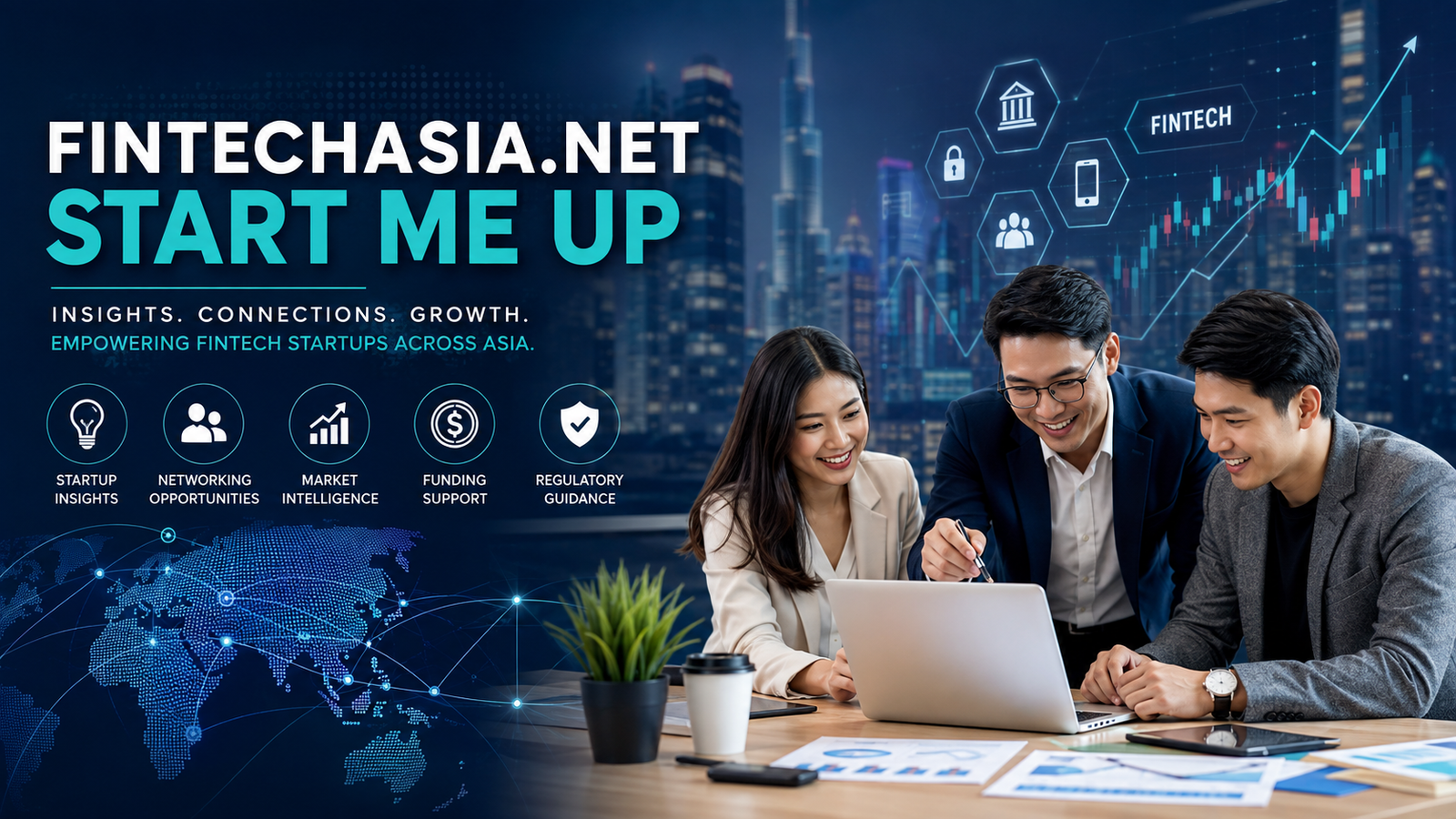
The FintechAsia .net Start Me Up initiative has attracted attention among entrepreneurs, fintech professionals, and startup enthusiasts looking for practical ways to understand Asia’s rapidly changing financial technology landscape. With digital payments, online banking, artificial intelligence, blockchain, and embedded finance continuing to reshape the industry, new founders need more than a good idea to build a successful fintech business.
They also need market knowledge, reliable information, industry connections, regulatory awareness, and a clear plan for turning an idea into a useful product.
FinTechAsia.net presents its Start Me Up content as a practical resource for founders and professionals interested in fintech opportunities across Asia. Its current material discusses areas such as startup validation, market research, funding activity, regulatory considerations, networking, and content-driven industry insights.
This guide explains what the Start Me Up concept is, who may benefit from it, what founders should look for, and how to approach a fintech launch more strategically.
What Is FinTechAsia .Net Start Me Up?
At its core, Start Me Up is positioned around the needs of fintech entrepreneurs who want to move from an early idea toward a more practical business strategy.
The current FinTechAsia material describes a startup-focused ecosystem covering areas such as market validation, fintech trends, startup listings, industry data, networking, and launch planning.
Rather than treating fintech as a single industry, the approach recognizes that financial technology covers many different sectors. These include:
- Digital payments
- Online and mobile banking
- Lending technology
- Wealth management
- Insurtech
- Regtech
- Digital identity
- Blockchain and tokenization
- Financial infrastructure
- Embedded finance
For a new founder, this broader perspective can be valuable. A strong fintech product is not simply about adding technology to financial services. It must solve a genuine problem while also considering security, regulation, customer trust, and long-term scalability.
Why Fintech Startups Need More Than a Good Idea
Starting a conventional software company can already be challenging. Building a financial technology business introduces another layer of complexity.
A fintech startup may need to deal with licensing requirements, customer verification, data protection, fraud prevention, payment infrastructure, financial regulations, and relationships with banks or other financial institutions.
That means an idea that sounds excellent on paper may not necessarily work in the real market.
A startup-focused resource can help founders think through questions such as:
- Who has the problem?
- How serious is the problem?
- What are customers using today?
- Is there enough demand for a new solution?
- Which market should be targeted first?
- What regulations could affect the product?
- How will the company make money?
- What technology is required for the first version?
These questions are often more important than simply having a long list of features.
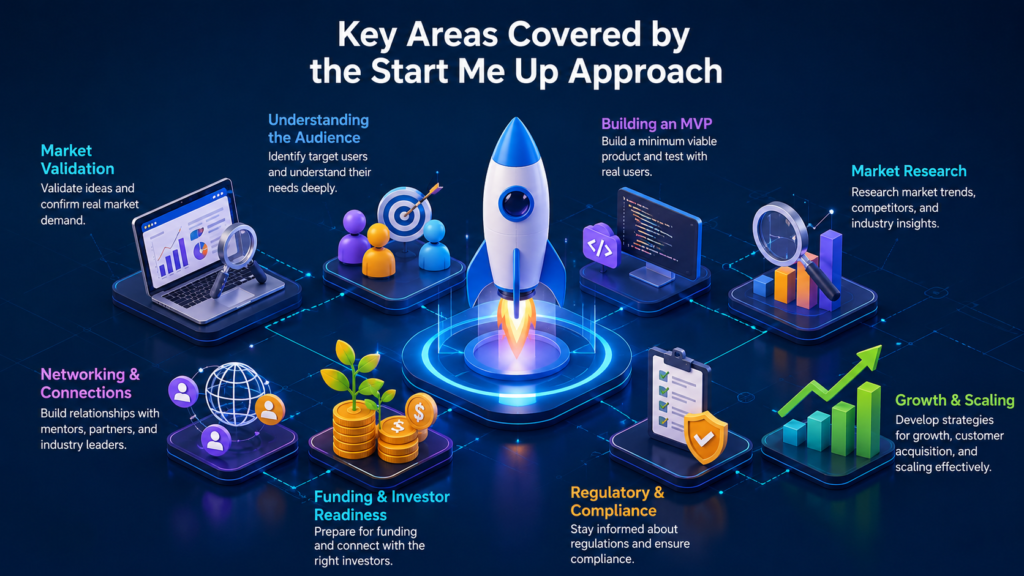
Key Areas Covered by the Start Me Up Approach
The information currently associated with Start Me Up places considerable emphasis on practical startup development. FinTechAsia’s 2026 launch playbook, for example, discusses validation, audience segmentation, MVP development, content strategy, partnerships, and measurable growth goals.
Here are some of the most important areas founders should understand.
Market Validation
Market validation should come before major investment.
Instead of spending months developing a product and hoping people will use it, founders can first test whether their proposed solution addresses a meaningful need.
Simple validation methods include:
- Customer interviews
- Landing pages
- Surveys
- Waitlists
- Prototype demonstrations
- Competitor research
- Small advertising experiments
- Pilot programs
The objective is not to prove that every customer will buy the product. It is to collect enough evidence to decide whether the idea deserves further investment.
Understanding the Target Audience
Fintech products can serve very different audiences.
A payment application for small businesses will have different requirements from an investment platform designed for institutional users. Likewise, a digital banking product may need a completely different user experience from a financial compliance solution.
Current Start Me Up material identifies founders, investors, operators, and regulators among the audiences relevant to a regional fintech information platform.
Clearly defining the audience helps a startup determine:
- What problem to solve
- Which features matter most
- What language to use
- Which distribution channels to prioritize
- How to price the product
Building a Minimum Viable Product
One of the biggest mistakes new founders make is trying to build everything at once.
A minimum viable product, or MVP, focuses on the smallest useful version of an idea. It should contain enough functionality to solve the core problem and generate meaningful user feedback.
For example, a fintech startup creating a business payment platform might initially focus on:
- Account creation
- Identity verification
- A basic payment function
- Transaction history
- Customer support
Advanced analytics, complex automation, loyalty programs, and additional integrations can potentially come later.
The goal is to learn quickly without wasting resources.
FinTechAsia’s current launch guidance similarly emphasizes a lean MVP and incremental development rather than attempting to build a fully expanded platform immediately.
Market Research Can Improve Startup Decisions
Fintech markets differ considerably from one Asian country to another.
Consumer behavior, payment preferences, financial infrastructure, regulations, and banking systems can all vary. A product that works well in one market may require substantial changes before entering another.
This is why market research should be treated as an ongoing process.
Founders can investigate:
- Existing competitors
- Market size
- Customer behavior
- Funding activity
- Regulatory requirements
- Technology adoption
- Pricing models
- Partnership opportunities
- Barriers to entry
The Start Me Up material describes the use of market information, deal activity, regulatory notes, and other signals to help founders make better decisions.
Networking and Industry Connections
Relationships can be particularly important in fintech.
A startup may need relationships with banks, payment providers, technology companies, regulators, investors, compliance specialists, and other financial institutions.
Networking can help founders discover opportunities that are difficult to find through ordinary online research.
For example, a founder may discover:
- A potential technology partner
- An experienced mentor
- An investor interested in the sector
- A pilot customer
- A regulatory specialist
- A strategic business partner
However, networking should not be treated as simply collecting contacts. The strongest relationships are usually built around genuine value, clear communication, and shared interests.
Funding and Investor Readiness
Funding is another major concern for fintech founders.
Depending on the business model, startups may consider bootstrapping, angel investment, venture capital, strategic investment, grants, or partnerships.
Before approaching investors, however, founders should understand their numbers.
A basic investor-ready package may include:
- The problem being solved
- Target market
- Product explanation
- Competitive landscape
- Business model
- Early traction
- Customer acquisition strategy
- Financial projections
- Funding requirement
- Planned use of capital
Investors generally want to understand not only what the product does, but also why the business can grow.
Important Features to Look for in a Fintech Startup Resource
The following table summarizes the areas that can make a startup-focused fintech resource useful.
Area | Why It Matters | What Founders Can Gain
Market research Reveals demand and competition Better market selection
Startup validation Tests ideas before major spending Reduced product risk
Industry insights Keeps founders informed Better strategic decisions
Networking Creates professional relationships Partners, mentors, and opportunities
Regulatory information Helps identify compliance concerns More realistic launch planning
Funding guidance Improves investor preparation Stronger fundraising strategy
MVP planning Keeps development focused Faster customer feedback
Content and community Builds visibility Audience and brand awareness
These areas should work together rather than being treated as isolated services.
How Founders Can Use the Platform More Effectively
Simply reading fintech articles is unlikely to create a successful startup. The real value comes from turning information into action.
A practical approach could look like this:
Start With One Specific Problem
Avoid beginning with a vague objective such as “I want to build a fintech app.”
Instead, identify a specific problem.
For example, small businesses may struggle with cash-flow management, international payments, invoice collection, or financial reporting.
A narrow problem creates a clearer starting point.
Research the Market
Once the problem is identified, investigate existing solutions.
Look at competitors, customer complaints, pricing, market gaps, and regulatory requirements.
Do not assume that the absence of a competitor means there is an opportunity. Sometimes there is no competitor because the problem is difficult, expensive, or heavily regulated.
Build a Focused MVP
Create the simplest product capable of solving the primary problem.
Then put it in front of real users.
Their feedback can reveal problems that founders may never notice during internal testing.
Measure Real Results
Useful measurements might include:
- Sign-ups
- Active users
- Conversion rates
- Customer retention
- Transaction volume
- Revenue
- Customer acquisition cost
- Support requests
Numbers provide a clearer picture than assumptions.
Security and Compliance Should Come First
Fintech businesses handle information that can be highly valuable to criminals.
Security therefore cannot be treated as an optional feature that gets added after launch.
Founders should consider areas such as encryption, authentication, access controls, fraud monitoring, secure software development, data protection, and incident response.
Regulatory compliance is equally important.
The exact requirements depend on the service and jurisdiction. A company dealing with payments, lending, investments, digital assets, or customer financial information may face very different obligations.
Before launching in a specific country, founders should obtain appropriate professional and legal advice rather than relying solely on general online information.
Common Mistakes New Fintech Founders Should Avoid
The fintech sector offers major opportunities, but it also has serious risks.
Some common mistakes include:
- Building before validating demand
- Ignoring regulatory requirements
- Trying to serve too many markets at once
- Adding unnecessary features
- Underestimating cybersecurity
- Focusing entirely on technology
- Having no clear revenue model
- Choosing growth over customer trust
- Ignoring customer support
- Assuming funding automatically means product-market fit
A startup can have impressive technology and still fail if customers do not trust it or cannot understand its value.
Is Start Me Up Suitable for Every Startup?
Not necessarily.
A founder developing a general consumer application may find a fintech-specific resource less relevant than someone building a financial technology product.
The greatest potential value is likely for people working around fintech, financial services, digital payments, investment technology, banking infrastructure, compliance technology, or related areas.
The current Start Me Up material is particularly focused on helping founders understand markets, validate ideas, develop lean products, connect with relevant people, and establish measurable growth strategies.
Potential users include:
- First-time fintech founders
- Early-stage startup teams
- Fintech professionals
- Entrepreneurs exploring Asian markets
- Investors researching emerging opportunities
- Product managers
- Financial technology researchers
What to Consider Before Relying on Any Startup Platform
Online startup resources can be useful, but they should not replace independent research.
Information can become outdated, particularly in financial technology. Regulations, market conditions, funding trends, and technology standards can change quickly.
Before making an important business decision, verify:
- Whether the information is current.
- Whether it applies to your target country.
- Whether the source is authoritative.
- Whether professional advice is required.
- Whether the claims can be independently confirmed.
This is especially important when dealing with financial regulations, investments, customer funds, or sensitive personal data.
The Future of Fintech Entrepreneurship in Asia
Asia remains an important region for financial technology innovation because of its diverse markets, growing digital economies, widespread mobile usage, and rapidly evolving payment ecosystems.
At the same time, the next generation of fintech startups will face higher expectations.
Customers increasingly expect financial products to be fast, convenient, transparent, and secure. Regulators are also paying closer attention to consumer protection, data privacy, financial crime, and operational resilience.
Artificial intelligence is another major factor. AI can improve fraud detection, customer service, financial analysis, personalization, and internal operations. But its use also introduces questions around data quality, transparency, security, and responsible deployment.
For founders, the opportunity is therefore significant—but so is the responsibility.
Frequently Asked Questions
What is fintechasia .net start me up?
It is a startup-focused concept associated with FinTechAsia.net that provides information and practical guidance around fintech entrepreneurship, market validation, industry opportunities, startup development, and growth. Current FinTechAsia material positions it toward founders and other professionals interested in Asia’s fintech ecosystem.
Who can benefit from Start Me Up?
Early-stage fintech founders, entrepreneurs, startup teams, investors, product professionals, and people researching Asian financial technology markets may find the information useful. Its relevance depends on the user’s specific business goals and market.
Does Start Me Up guarantee funding for startups?
No startup resource should be treated as a guaranteed source of investment. Funding depends on factors such as the business model, market opportunity, traction, team, financials, investor interest, and regulatory environment.
Can beginners use FinTechAsia startup resources?
Yes. Beginners can use startup-focused material to learn about market research, MVP development, fintech trends, business models, and other fundamentals. However, beginners should conduct additional research before making financial or regulatory decisions.
Why is market validation important for fintech startups?
Validation helps determine whether customers actually have the problem a startup intends to solve. It can reduce wasted development costs and reveal weaknesses in an idea before significant money and time are invested.
What should a fintech founder prioritize first?
A founder should generally begin by identifying a real customer problem, researching the market, checking regulatory requirements, validating demand, and designing a focused MVP. Security and compliance should be considered from the beginning rather than added later.
Final Thoughts
The fintechasia .net start me up concept reflects an important reality of modern financial technology: successful startups need much more than innovative software. They need market understanding, customer validation, regulatory awareness, strong relationships, secure technology, and a realistic growth strategy.
Also Read: UpdateArticle.com: A Complete Guide to the Digital Publishing and Information Platform





Leave a Reply