

Ethereum is one of the most important blockchain platforms in the cryptocurrency world. While many people first discover it through its digital currency, Ether (ETH), the network is much more than a way to send and receive digital money. It provides a platform where developers can build decentralized applications, smart contracts, digital assets, and other blockchain-based services.
For beginners, the terminology surrounding blockchain and cryptocurrency can seem complicated. Ethereum becomes easier to understand when its main components are separated into simple ideas. This guide explains what the network is, how it works, what makes it different from Bitcoin, and why it continues to attract developers and users.
What Is Ethereum?
Ethereum is a decentralized blockchain network designed to support programmable applications and transactions without requiring a central authority to control them.
The project was proposed by Vitalik Buterin and launched in 2015. Unlike a traditional financial platform, its infrastructure is maintained by a distributed network of computers around the world.
The native cryptocurrency of the network is called Ether, commonly represented by the ticker ETH. ETH is used for transactions, network fees, staking, and various applications built on the blockchain.
One of the most important ideas behind Ethereum is programmability. Instead of only recording transfers of cryptocurrency, its blockchain can execute pieces of code known as smart contracts.
This ability opened the door to a broad ecosystem of decentralized applications.
How Ethereum Works
At a basic level, the network works by allowing computers participating in the blockchain to agree on the state of transactions and applications.
When someone sends ETH or interacts with a decentralized application, the request is submitted to the network. The transaction must then be processed and recorded according to Ethereum’s rules.
Several important concepts help explain this process.
Blockchain
A blockchain is a distributed digital ledger. Instead of keeping transaction records in one centralized database, copies of the network’s data are maintained across many participating computers.
Transactions are grouped and processed according to the network’s consensus rules. Once information is recorded on the blockchain, changing historical records is intentionally difficult.
This decentralized structure helps reduce dependence on a single organization.
Smart Contracts
Smart contracts are programs that run on the blockchain. They can automatically perform actions when predefined conditions are met.
For example, a smart contract could be designed to transfer a digital asset after receiving a particular payment. The rules are written into code rather than being manually enforced by a central intermediary.
Smart contracts are used for many purposes, including:
- Decentralized finance applications
- Digital collectibles
- Token creation
- Decentralized exchanges
- Blockchain games
- Automated agreements
- Community and governance systems
The concept is important because it allows blockchain networks to support applications rather than simply functioning as payment systems.
What Is ETH?
ETH is the native cryptocurrency of the Ethereum network.
It is often described as the fuel that helps the network operate because users generally need ETH to pay transaction fees. These fees compensate validators for processing and securing activity on the blockchain.
ETH can also be held as a digital asset or used within applications built on the network.
It is important for beginners to distinguish between Ethereum and ETH:
| Term | Meaning | Main Purpose |
|---|---|---|
| Ethereum | Blockchain network and platform | Runs decentralized applications and smart contracts |
| ETH | Native cryptocurrency | Fees, transactions, staking, and ecosystem activity |
| Smart contract | Blockchain-based program | Automates predefined actions |
| Gas | Measurement associated with computation | Helps determine network transaction costs |
| Validator | Network participant | Helps secure and validate the blockchain |
This distinction makes many cryptocurrency discussions much easier to follow.
What Are Ethereum Gas Fees?
Gas refers to the computational work required to perform operations on the network.
When you make a transaction or interact with a smart contract, the network requires computational resources. A fee is therefore associated with processing the operation.
This is commonly called a gas fee.
The amount a user pays can vary depending on several factors, including the complexity of the transaction and network demand.
For example, a simple transfer may require less computational work than interacting with a complex decentralized application.
Gas fees can also become more noticeable when network activity increases. This is one reason beginners may see different transaction costs at different times.
Understanding gas is important because the amount of ETH in a wallet is not necessarily the entire amount available for a transaction. Users generally need to account for the associated network fee as well.
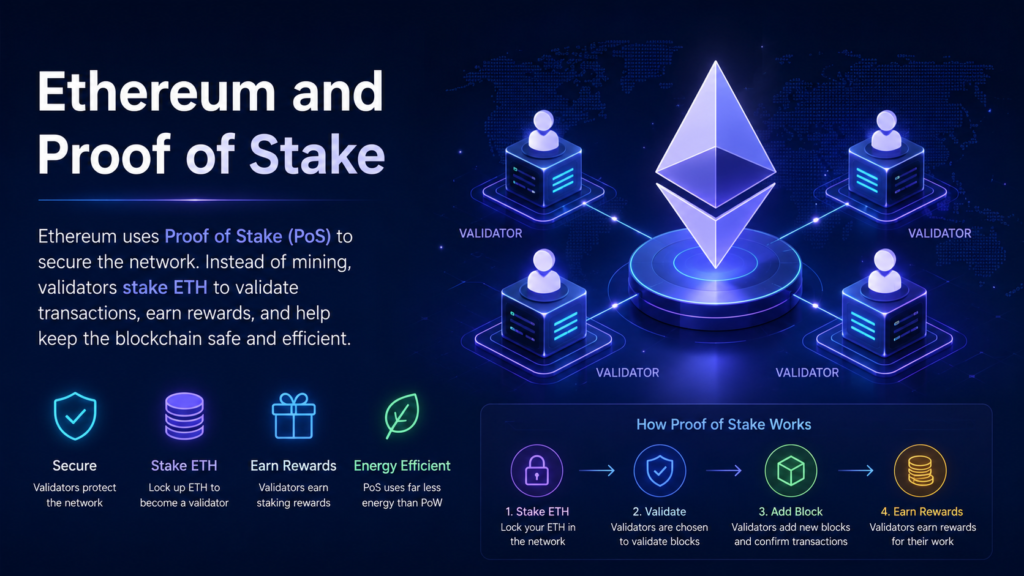
Ethereum and Proof of Stake
Ethereum originally used a proof-of-work consensus system, but the network transitioned to proof of stake in 2022.
Under proof of stake, validators help maintain network security by participating with ETH according to the protocol’s rules.
Instead of relying on large amounts of computing power to compete for block production, proof-of-stake systems use economic incentives and penalties to encourage honest participation.
The transition was a major technical change for the network.
For beginners, the simplest way to think about it is that validators help verify and organize network activity while putting value at risk according to the protocol’s requirements.
What Is Staking?
Staking involves committing ETH to help support the proof-of-stake network.
Validators perform important duties, such as participating in consensus and helping maintain the blockchain.
In return, participants can potentially receive rewards according to the network’s rules and conditions.
However, staking is not the same as a guaranteed-interest savings account. Cryptocurrency rewards can vary, and technical, market, liquidity, and protocol-related risks may exist.
Beginners should understand these risks before committing funds.
Some users may also access staking through third-party services, but this introduces additional considerations because the user may be relying on another organization.
What Can Ethereum Be Used For?
The network has developed into a broad ecosystem rather than serving only as a cryptocurrency payment system.
Some major use cases include:
Decentralized Finance
Decentralized finance, commonly called DeFi, uses blockchain-based applications to provide financial services through smart contracts.
Depending on the application, users may be able to swap assets, lend or borrow digital tokens, provide liquidity, or interact with other financial protocols.
These systems can operate without the traditional structure of a bank or brokerage, although they carry their own technical and financial risks.
Digital Assets and NFTs
Ethereum helped popularize blockchain-based digital collectibles and NFTs.
An NFT can represent ownership or another type of relationship with a unique digital asset. NFTs have been used for art, collectibles, gaming items, memberships, tickets, and other applications.
The technology is broader than digital artwork alone.
Decentralized Applications
Decentralized applications, often called dApps, use smart contracts and blockchain infrastructure to provide services.
These applications can cover areas such as finance, gaming, social platforms, marketplaces, identity systems, and digital ownership.
The important difference is that some of their core functions are handled by blockchain-based code rather than a conventional centralized database.
Ethereum vs. Bitcoin
Ethereum and Bitcoin are both major blockchain networks, but they were designed with different primary objectives.
Bitcoin was introduced primarily as a decentralized digital monetary system. Ethereum expanded the concept by creating a programmable blockchain capable of running smart contracts and decentralized applications.
| Feature | Ethereum | Bitcoin |
| Primary purpose | Programmable blockchain ecosystem | Decentralized digital money |
| Native asset | ETH | BTC |
| Smart contracts | Core capability | More limited scripting capabilities |
| Consensus | Proof of stake | Proof of work |
| Applications | Large ecosystem of dApps and protocols | Primarily focused on monetary use |
| Launch | 2015 | 2009 |
Neither network should simply be viewed as a replacement for the other. They serve different purposes and have developed different ecosystems.
Why Ethereum Matters to Crypto Beginners
Understanding Ethereum provides a useful foundation for learning about the broader blockchain industry.
Many concepts that appear throughout cryptocurrency—such as smart contracts, tokens, decentralized applications, gas fees, staking, and decentralized finance—are closely associated with the ecosystem.
Learning how the network works can therefore make other blockchain topics easier to understand.
It also teaches an important lesson about cryptocurrency: blockchain networks can be more than digital currencies. They can provide infrastructure for programmable applications and digital ownership.
Benefits of Ethereum
The network has several characteristics that have contributed to its popularity.
Decentralization
The network operates across a distributed infrastructure rather than relying on one central database or administrator.
Programmability
Developers can create smart contracts and applications that operate according to predefined blockchain rules.
Large Ecosystem
A broad collection of applications, developers, users, tokens, and infrastructure providers has developed around the network.
Digital Ownership
Blockchain-based assets can provide new ways of representing ownership, access, and participation.
Open Development
Developers around the world can build applications using publicly available blockchain infrastructure and tools.
These benefits do not eliminate risks, but they help explain why Ethereum remains an important part of the cryptocurrency landscape.
Risks Beginners Should Understand
Cryptocurrency technology can be useful and innovative, but it also involves significant risks.
The price of ETH can be highly volatile. Its market value can rise or fall substantially over relatively short periods.
Smart contracts can also contain programming errors. Even when a blockchain itself operates as intended, applications built on top of it may have vulnerabilities.
Other risks can include:
- Losing access to a cryptocurrency wallet
- Sending assets to an incorrect address
- Paying unexpected network fees
- Using fraudulent applications or websites
- Falling for phishing attacks
- Depending on unreliable third-party services
- Making financial decisions based on hype
Beginners should never assume that a popular blockchain or cryptocurrency is automatically risk-free.
How Beginners Can Start Learning
There is no need to understand every technical detail immediately.
A practical learning path is to start with the fundamentals:
- Learn the difference between Ethereum and ETH.
- Understand what a blockchain does.
- Learn how smart contracts work.
- Understand gas fees.
- Learn the basics of proof of stake.
- Explore what decentralized applications are.
- Study cryptocurrency wallet security.
- Learn about common scams before using blockchain applications.
Security deserves special attention.
Never share a wallet’s recovery phrase or private key with another person. Be cautious with unexpected messages, fake support accounts, suspicious websites, and promises of guaranteed cryptocurrency profits.
Taking time to verify information can prevent expensive mistakes.

The Future of Ethereum
The development of Ethereum continues to focus on improving the network’s scalability, efficiency, security, and overall user experience.
One important part of the broader ecosystem is the use of layer-2 networks. These systems are designed to process activity using additional infrastructure connected to Ethereum, helping expand transaction capacity and potentially reduce costs for certain types of activity.
The ecosystem is also evolving as developers experiment with new financial applications, digital identity concepts, gaming systems, tokenized assets, and other blockchain-based services.
However, predicting the exact future of any cryptocurrency network is difficult. Technology, regulation, competition, user adoption, and market conditions can all influence its development.
For beginners, it is better to understand the technology and its risks than to rely on predictions about future prices.
Frequently Asked Questions
Is Ethereum a cryptocurrency?
Ethereum is primarily a blockchain network and programmable platform. Its native cryptocurrency is ETH, which is used for transactions, network fees, staking, and activity throughout the ecosystem.
What is ETH used for?
ETH can be used to pay network fees, transfer value, participate in staking, and interact with applications built on the Ethereum blockchain. It can also be held as a digital asset.
Is Ethereum the same as Bitcoin?
No. Bitcoin and Ethereum are separate blockchain networks with different designs and primary goals. Bitcoin focuses mainly on decentralized digital money, while Ethereum is designed as a programmable platform for smart contracts and decentralized applications.
What are Ethereum gas fees?
Gas fees are costs associated with the computational work required to process operations on the network. The final amount can vary depending on the transaction and current network conditions.
Is Ethereum safe for beginners?
The underlying network uses decentralized security mechanisms, but using cryptocurrency applications still involves risks. Users can lose funds through scams, compromised accounts, faulty applications, incorrect transactions, or poor wallet security.
Can beginners use Ethereum without being technical experts?
Yes. Beginners do not need programming knowledge to learn about or use basic Ethereum applications. However, understanding wallets, transaction confirmations, network fees, and security practices is important before moving significant funds.
Final Thoughts
Ethereum has helped expand the idea of what blockchain technology can accomplish. Instead of functioning only as a system for transferring digital money, it provides infrastructure for smart contracts, decentralized applications, digital assets, and a growing range of blockchain-based services.
For newcomers, the most important concepts to understand are the difference between Ethereum and ETH, the role of smart contracts, how gas fees work, and how proof of stake supports the network.
There is plenty more to explore, but learning these fundamentals provides a strong starting point. As with any cryptocurrency technology, users should continue researching, protect their wallets carefully, and make financial decisions based on reliable information rather than hype.
Also Read: How to Use InnoCams: A Simple Guide for New Visitors











Leave a Reply