

If you are researching husch blackwell, you are likely looking for information about the firm, the legal services it provides, its areas of practice, and the types of clients it serves. Husch Blackwell is a major U.S. law firm with a broad range of legal capabilities covering business, litigation, regulatory matters, real estate, healthcare, technology, and other industries.
Understanding a law firm before choosing legal representation can be important. Beyond its size, prospective clients often want to know whether a firm has experience in their particular industry, handles matters of similar complexity, and offers the right combination of legal knowledge and practical advice.
This guide provides an overview of Husch Blackwell, its practice areas, industries, approach to legal work, and factors worth considering when evaluating the firm.
What Is Husch Blackwell?
Husch Blackwell is a U.S.-based law firm that provides legal services to businesses, organizations, institutions, and individuals. The firm operates across numerous legal practice areas and industry sectors, allowing it to handle both routine legal needs and complex matters.
Large law firms typically bring together attorneys with specialized knowledge in different areas of law. This can be useful for clients whose legal issues cross multiple disciplines.
For example, a company dealing with a major transaction may need assistance with contracts, employment considerations, regulatory requirements, tax issues, intellectual property, and litigation risk. A multidisciplinary legal team can coordinate these issues rather than treating each one separately.
Husch Blackwell’s broad structure makes it possible to provide legal support across a variety of situations.
Husch Blackwell at a Glance
The following table gives a simplified overview of what prospective clients may want to know about the firm.
| Category | Overview |
|---|---|
| Organization type | U.S. law firm |
| Primary market | United States |
| Client base | Businesses, organizations, institutions, and individuals |
| Legal focus | Corporate, litigation, regulatory, transactional, and industry-specific matters |
| Practice structure | Multiple specialized legal practice areas |
| Industry experience | Broad range of commercial and regulated industries |
| Typical matters | Transactions, disputes, compliance, contracts, investigations, and advisory work |
The exact attorney, office, and practice group involved in a matter will depend on the client’s needs.
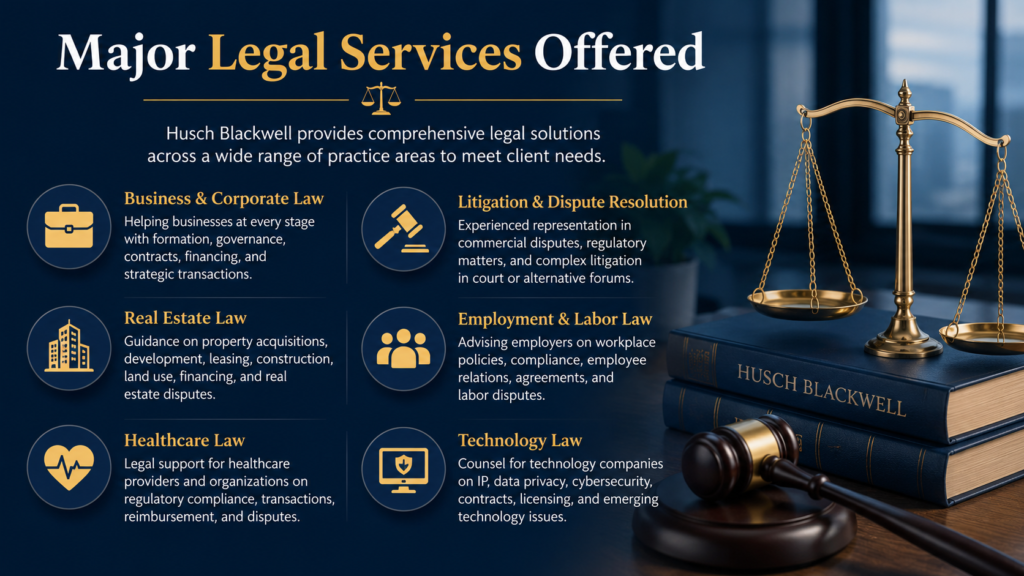
Major Legal Services Offered
One of the most important considerations when researching a law firm is whether its services match your legal requirements.
Husch Blackwell works across numerous legal disciplines. Some of the key areas include the following.
Business and Corporate Law
Businesses regularly encounter legal questions involving formation, governance, contracts, acquisitions, financing, and strategic transactions.
Corporate attorneys can help companies structure transactions, negotiate agreements, manage legal risks, and address issues that arise during different stages of business growth.
For larger organizations, corporate legal work can become particularly complex when several regulatory and commercial considerations overlap.
Litigation and Dispute Resolution
Legal disputes can affect a company’s finances, reputation, operations, and relationships with customers or business partners.
Litigation lawyers may represent clients in commercial disputes, contractual disagreements, regulatory matters, and other contested proceedings.
Effective dispute management is not always about going to trial. In many situations, negotiation, mediation, arbitration, or another resolution strategy may be more appropriate.
Real Estate Law
Real estate transactions often involve much more than buying or selling property.
Legal issues can include:
- Property acquisitions and dispositions
- Development projects
- Leasing arrangements
- Financing
- Construction agreements
- Land-use questions
- Environmental considerations
- Property disputes
Experienced real estate lawyers can help clients identify legal risks before a transaction is completed.
Employment and Labor Law
Employers must navigate an increasingly complicated workplace environment.
Employment attorneys may advise organizations on matters involving workplace policies, employee relationships, wage and hour requirements, discrimination claims, employment agreements, and disputes.
Businesses often benefit from obtaining legal guidance before a workplace issue develops into a formal dispute.
Industry-Specific Legal Knowledge
A major advantage of a large legal organization is the ability to combine knowledge of law with understanding of particular industries.
Husch Blackwell works with clients across a wide variety of sectors.
Healthcare
Healthcare organizations operate in a highly regulated environment. Hospitals, healthcare providers, companies, and other organizations may encounter legal issues involving compliance, transactions, reimbursement, privacy, employment, and disputes.
Industry-specific legal knowledge can be particularly valuable because healthcare decisions frequently involve both commercial and regulatory considerations.
Financial Services
Financial institutions and related businesses face extensive regulatory obligations.
Legal counsel may assist with compliance, transactions, investigations, litigation, corporate matters, and regulatory developments.
Energy and Natural Resources
The energy sector can involve complex commercial agreements, environmental requirements, regulatory matters, infrastructure projects, and disputes.
Law firms serving this industry need to understand both the legal framework and the practical realities of energy projects.
Technology
Technology companies often deal with intellectual property, contracts, data, privacy, cybersecurity, employment, financing, and corporate transactions.
As technology becomes increasingly integrated into traditional businesses, these legal considerations can affect companies across many industries rather than technology companies alone.
Education
Educational institutions face unique legal requirements involving governance, employment, compliance, student matters, contracts, and disputes.
Legal counsel with experience in education can help institutions understand obligations that differ from those faced by ordinary commercial businesses.
Why Businesses Work With Large Law Firms
There are several reasons an organization might choose a large law firm instead of a smaller legal practice.
One consideration is breadth of expertise. A business may begin with one legal problem and discover that it also has tax, employment, regulatory, or litigation implications.
Another factor is capacity. Complex matters can require several attorneys working on different aspects of the same project.
Large firms may also have experience handling significant transactions and disputes, which can be useful when the legal stakes are high.
However, size alone should not determine whether a law firm is right for a particular client. The relevant attorney’s experience, communication style, fees, availability, and understanding of the client’s objectives are equally important.
What Should You Consider Before Hiring a Law Firm?
If you are considering Husch Blackwell or another law firm, it helps to evaluate several factors before making a decision.
Relevant Experience
Start by identifying whether the attorney or practice group has handled matters similar to yours.
A firm may have extensive experience overall, but that does not automatically mean every lawyer is suitable for every legal issue.
Ask about experience with:
- Your industry
- Your type of legal matter
- Similar disputes or transactions
- Applicable state or federal regulations
- Businesses of comparable size or complexity
Communication
Good legal representation depends heavily on communication.
Before hiring counsel, consider how clearly the attorney explains complicated legal concepts and whether you understand how communication will work throughout the engagement.
You should know who will be your primary contact and how urgent questions will be handled.
Fees and Billing
Legal fees can vary considerably depending on the nature and complexity of the matter.
Ask about the expected billing arrangement and what services are included. Depending on the engagement, billing may involve hourly rates, fixed fees, retainers, or other arrangements.
A clear discussion about fees at the beginning can help avoid misunderstandings later.
Team Structure
For a large legal matter, you may interact with several attorneys and legal professionals.
It is reasonable to ask who will lead the matter, which lawyers will be involved, and how responsibilities will be divided.
Understanding the team structure can make the process more predictable.
How to Prepare for an Initial Legal Consultation
Whether you are contacting Husch Blackwell or another attorney, preparation can make an initial consultation more productive.
Gather documents relevant to your matter, such as contracts, correspondence, notices, agreements, financial records, or court documents when applicable.
It can also help to create a short timeline of important events.
Before the meeting, write down your main questions. This can prevent important concerns from being forgotten during the conversation.
Useful questions may include:
- What legal issues do you see in my situation?
- What options are available?
- What risks should I understand?
- What information do you need from me?
- What could the process cost?
- What are the likely next steps?
You do not need to understand every legal concept before speaking with a lawyer. Providing accurate information and asking clear questions is usually more valuable.
The Importance of Industry Knowledge
Modern legal problems rarely exist in isolation.
For example, a technology company facing a contract dispute may simultaneously have concerns about intellectual property, data privacy, employment, and regulatory compliance.
Likewise, a healthcare organization involved in a transaction may need advice involving corporate law, healthcare regulations, employment, financing, and real estate.
This is why industry knowledge can be just as important as general legal expertise.
A lawyer who understands the commercial environment surrounding a legal issue may be better positioned to provide practical advice rather than simply identifying legal rules.

Is Husch Blackwell Suitable for Every Client?
No single law firm is the perfect choice for every person or organization.
Husch Blackwell’s broad capabilities may make it attractive for businesses and organizations with sophisticated or multidisciplinary legal needs. However, a smaller law firm or specialist attorney may be a better fit for some clients, particularly when the matter is narrow or highly localized.
The right choice depends on factors such as:
- Type of legal problem
- Location and applicable jurisdiction
- Industry
- Matter complexity
- Budget
- Required specialization
- Desired level of attorney involvement
Prospective clients should evaluate the specific lawyer and practice group rather than relying solely on the firm’s overall reputation or size.
Frequently Asked Questions
What is Husch Blackwell known for?
Husch Blackwell is a U.S. law firm with a broad legal practice serving businesses, organizations, institutions, and other clients. Its capabilities span areas such as corporate law, litigation, regulatory matters, real estate, employment, healthcare, technology, and other sectors.
Does Husch Blackwell handle business legal matters?
Yes. Business-related legal work can include corporate transactions, contracts, governance, mergers and acquisitions, financing, disputes, and regulatory matters. The appropriate practice group depends on the specific issue.
Can Husch Blackwell help with litigation?
The firm has litigation capabilities covering various types of disputes. The right attorney will depend on the nature of the dispute, the applicable jurisdiction, and the industry involved.
How should I choose a Husch Blackwell attorney?
Consider the lawyer’s experience with matters similar to yours, industry knowledge, jurisdictional experience, communication style, availability, and fee structure. Asking about the proposed legal team before engagement can also be helpful.
Is a large law firm always better than a small law firm?
Not necessarily. Larger firms can offer broad resources and multidisciplinary expertise, while smaller firms may provide more specialized or personalized service. The best choice depends on the complexity and requirements of your legal matter.
What should I bring to a first consultation?
Bring relevant contracts, correspondence, notices, agreements, court documents, and other records related to your issue. A concise timeline and list of questions can also help the attorney understand the situation efficiently.
Final Thoughts
Researching husch blackwell is a useful starting point for anyone trying to understand the firm’s legal capabilities and whether its services may fit a particular need. Its broad practice structure allows it to work across corporate, litigation, regulatory, real estate, employment, healthcare, technology, and other legal areas.
Still, choosing legal representation should involve more than looking at the name of a firm. The most important questions are whether the attorney understands your specific problem, has relevant experience, communicates effectively, and can provide a legal strategy that matches your goals and budget.
If you are evaluating legal counsel, compare your requirements with the firm’s relevant practice area and speak directly with an appropriate attorney before making a final decision. That approach can help you choose legal representation based on your actual needs rather than simply the size or reputation of a law firm.
Also Read: y2mate com: Overview, How It Works, Features, and What Users Should Know











Leave a Reply