
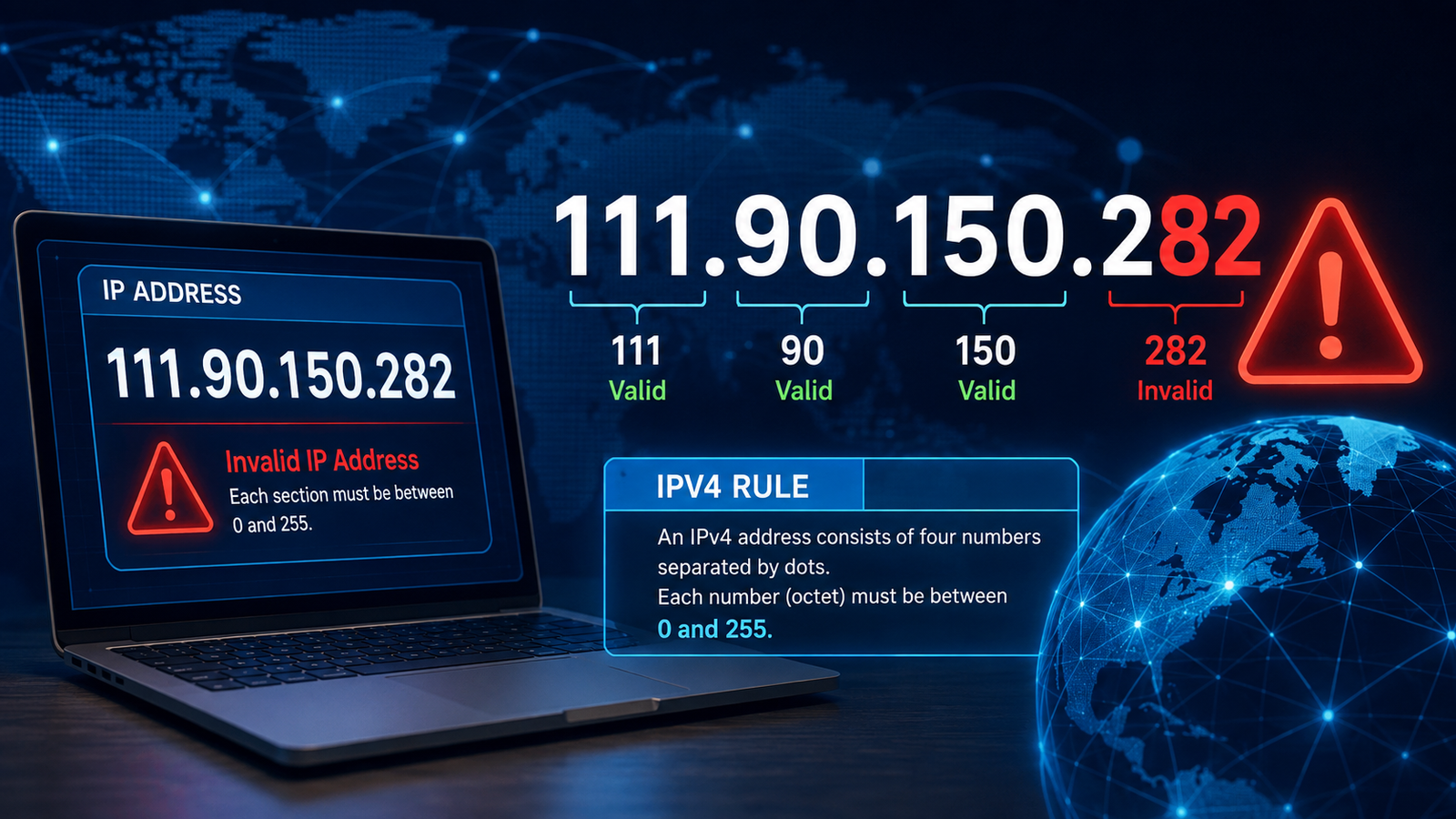
The keyword 111.90.150.282 looks like an IPv4 address, but there is an important detail to understand before trying to identify or use it. Standard IPv4 addresses contain four numerical sections separated by periods, and each section must be between 0 and 255. Because the final section of this address is 282, it does not meet the normal IPv4 format. This guide explains what 111.90.150.282 could represent, why it is considered invalid, how IP addresses work, and what to do if you encountered it in a website, application, log, or network message.
What Is 111.90.150.282?
At first glance, 111.90.150.282 follows the familiar structure of an IPv4 address. IPv4 addresses are written as four numbers separated by dots, such as 192.168.1.1 or 8.8.8.8.
However, there is a strict technical rule behind this format.
Each of the four numerical sections, commonly called octets, must have a value from 0 through 255.
The address in question contains these four sections:
| Octet | Value | Valid IPv4 Range | Status |
|---|---|---|---|
| First | 111 | 0–255 | Valid |
| Second | 90 | 0–255 | Valid |
| Third | 150 | 0–255 | Valid |
| Fourth | 282 | 0–255 | Invalid |
The first three numbers are within the permitted range. The problem is the final number, 282.
Since 282 is greater than 255, 111.90.150.282 is not a valid conventional IPv4 address.
Why 282 Cannot Be Used in a Normal IPv4 Address
IPv4 uses a 32-bit addressing system. Those 32 bits are divided into four groups of eight bits.
An eight-bit number can represent values from 0 to 255. This is why every octet in an IPv4 address has the same upper limit.
For example:
- 0 is valid
- 25 is valid
- 100 is valid
- 200 is valid
- 255 is valid
- 256 is invalid
- 282 is invalid
This means there is no ordinary IPv4 host with the exact address 111.90.150.282.
If you see this value somewhere, it may have been entered incorrectly, copied incorrectly, generated by a poorly designed system, or confused with another type of identifier.
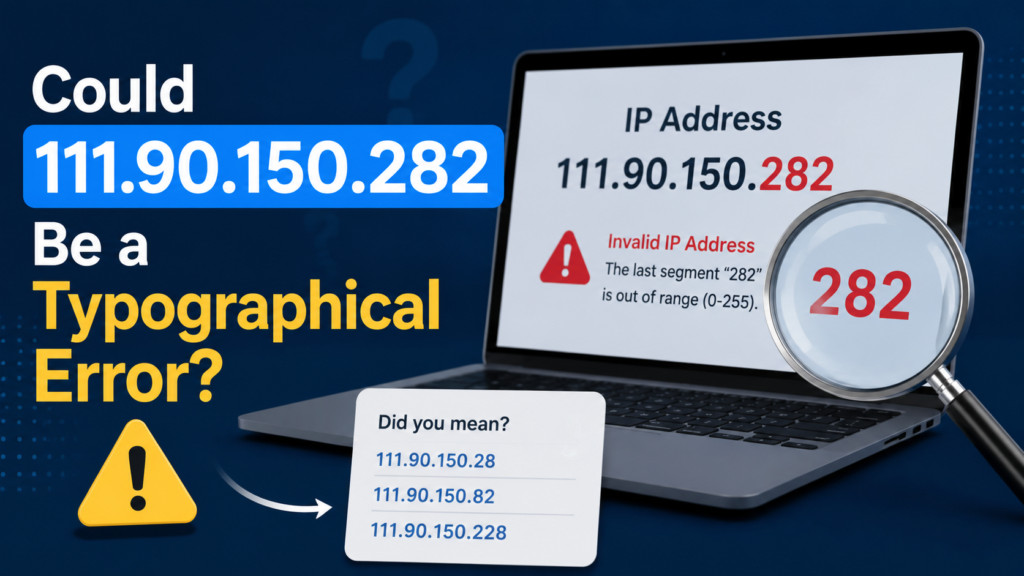
Could 111.90.150.282 Be a Typographical Error?
Yes. A typing or transcription mistake is one of the most likely explanations.
Someone may have intended to enter a similar-looking address but accidentally used 282 in the final position. For example, an actual address might have a final octet such as 82, 182, or 228.
It is important not to guess the intended address, though.
If you found the value in a server log, email, security report, website, or application, check the original source rather than changing the
yourself. One incorrect digit can point to an entirely different address.
How IPv4 Addresses Work
To understand why the keyword is invalid, it helps to know the basics of IPv4.
IPv4 stands for Internet Protocol version 4. It is one of the main addressing systems used by networks and internet-connected devices.
An IPv4 address contains four octets:
Example: 203.0.113.25
The address can be separated as:
- 203
- 0
- 113
- 25
Every part is represented using eight bits. Together, the four sections provide a 32-bit address.
IPv4 provides approximately 4.3 billion possible numerical addresses, although not all are available for public devices because some ranges are reserved for private networks, testing, documentation, multicast, and other purposes.
Is 111.90.150.282 a Public IP Address?
No. Because the final octet is outside the valid IPv4 range, 111.90.150.282 cannot function as a normal public IPv4 address.
A valid public IPv4 address must first satisfy the basic formatting rules. Only after that can it be evaluated for other characteristics, such as whether it belongs to a publicly routable range.
For example, an address such as 111.90.150.200 has correctly formatted octets. It could then be investigated using appropriate IP lookup or network tools.
The keyword 111.90.150.282, however, fails the first basic validation step.
What If You Found 111.90.150.282 in a Website or App?
If this address appeared on a website or inside an application, do not immediately assume that it represents a real user’s IP address.
There are several possibilities.
It May Be a Formatting Error
A developer, website owner, or user could have entered an invalid address manually.
It May Be Corrupted Data
Information can occasionally become corrupted when data is transferred, parsed, stored, or displayed.
It Could Be a Mistyped Address
A single extra or incorrect digit can turn a valid IP address into an invalid one.
It May Be Application-Specific Data
Some systems display numerical strings that resemble IP addresses but are actually identifiers, placeholders, or values generated by internal software.
It Could Be Part of a Security Log
Security tools sometimes record unusual input. If an invalid address appears in a log, it does not necessarily mean that a real device used that exact IP address.
How to Check Whether an IP Address Is Valid
Checking an IPv4 address is relatively simple.
First, separate the address into four parts.
For 111.90.150.282, the sections are:
111 | 90 | 150 | 282
Then check each number against the permitted range of 0–255.
The first three pass the test. The final section fails because 282 is greater than 255.
A simple validation checklist is:
- Does the address contain four numerical sections?
- Are the sections separated by periods?
- Is every section between 0 and 255?
- Are there unexpected letters or symbols?
- Was the address copied correctly from its original source?
If all four numerical sections fall within the required range, the address has a valid basic IPv4 format.
Does an Invalid IP Mean Your Device Is Hacked?
Not necessarily.
Seeing 111.90.150.282 somewhere does not by itself indicate hacking, malware, or unauthorized access.
An invalid IP address can result from something as simple as a typo or software formatting problem.
If you found it in a security alert, however, it is worth investigating the surrounding information. Look at the date, time, application, event type, source field, and other network details.
A security event should be evaluated based on the complete evidence rather than one unfamiliar number.
What to Do If You Received This IP in a Security Alert
If a security product, website, or server log showed 111.90.150.282, start by preserving the original record.
Avoid editing the value before investigating it.
You can then:
- Check whether the address was copied correctly.
- Review nearby log entries.
- Look for additional IP addresses in the same event.
- Confirm whether the system uses IPv4 or IPv6.
- Check whether the software has a known logging or parsing issue.
- Review the exact timestamp of the event.
- Contact the administrator or security provider if the alert appears serious.
If the address came from an email or suspicious message, be especially careful about clicking links or downloading attachments merely to investigate it.
IPv4 vs. IPv6: What’s the Difference?
Another reason people sometimes become confused by IP addresses is the difference between IPv4 and IPv6.
IPv4 normally looks like four decimal numbers separated by periods.
For example:
192.168.1.10
IPv6 uses a much longer hexadecimal format.
For example:
2001:db8::1
The two systems follow different formatting rules. An IPv6 address cannot be validated using IPv4’s four-octet system.
Because 111.90.150.282 uses the dotted-decimal format, it appears intended to be an IPv4 address. Its problem is that one of its four octets is outside the permitted range.
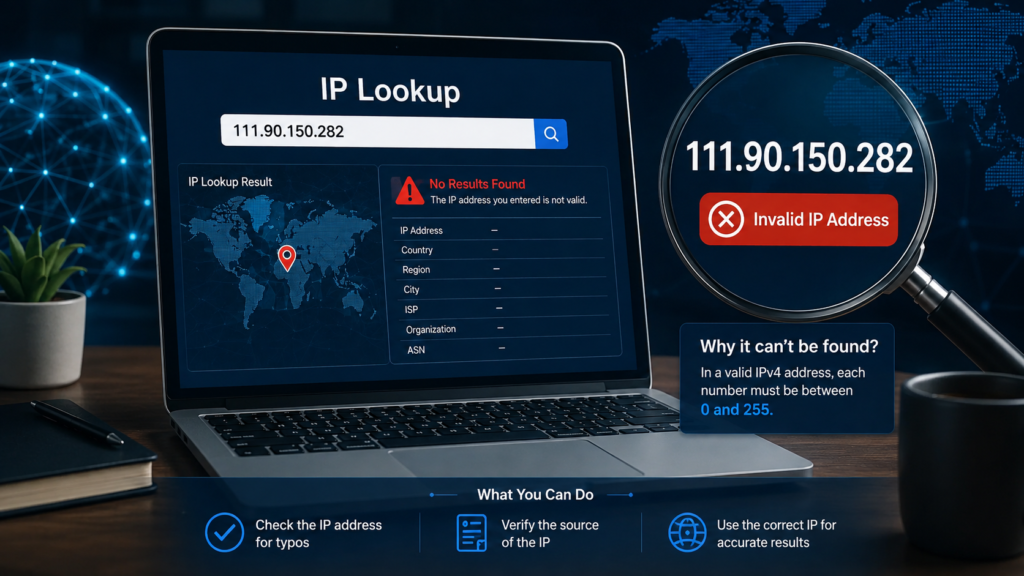
Can an IP Lookup Tool Find 111.90.150.282?
A conventional IP lookup service should not treat 111.90.150.282 as a valid IPv4 address.
IP lookup services generally need a properly formatted address before they can provide information such as:
- Approximate geographic region
- Internet service provider
- Autonomous system information
- Network organization
- Routing information
Because the address fails basic IPv4 validation, lookup results may return an error or indicate that the input is invalid.
If you have a corrected version of the address, use that exact value rather than assuming what the incorrect number was supposed to be.
Common Mistakes When Reading IP Addresses
IP addresses can be easy to misread, especially when they appear inside long technical logs.
Common mistakes include:
- Reading 282 instead of 82
- Copying an extra digit
- Replacing one digit with another
- Confusing an IP address with a port number
- Removing or adding punctuation
- Mixing IPv4 and IPv6 formats
- Treating an internal identifier as an IP address
For this reason, copying the original value directly from the source is usually better than typing it manually.
Is 111.90.150.282 Dangerous?
The number itself is not evidence that something is dangerous.
In fact, the exact value 111.90.150.282 is not a valid standard IPv4 address. Therefore, it should not be treated as a normal routable public IP address without additional context.
If you encountered it in a suspicious situation, focus on the surrounding activity rather than the number alone.
For example, a strange login notification, unexpected software installation, or repeated failed authentication attempts could be more meaningful security indicators.
Frequently Asked Questions
Is 111.90.150.282 a valid IP address?
No. It is not a valid standard IPv4 address because the final octet is 282, while IPv4 octets can only range from 0 to 255.
Why does 111.90.150.282 look like an IP address?
It follows the visual structure of an IPv4 address because it contains four numerical sections separated by periods. However, looking correct is not enough. Every section must also meet the IPv4 numerical range requirements.
Can 111.90.150.282 be traced?
The exact value cannot be treated as a normal public IPv4 address because it is invalid. If the value is a typo for another address, the corrected address may be traceable through legitimate network information and lookup services.
Does 111.90.150.282 belong to a specific country?
There is no reliable country assignment for the exact address because it is not a valid conventional IPv4 address. Do not assume a geographic location based on the first three numbers alone.
What should I do if I see this IP in my logs?
Keep the original log entry, check the surrounding records, and verify whether the address was entered or displayed incorrectly. If the event is associated with suspicious activity, investigate the complete event rather than relying on the IP alone.
Can an invalid IP address indicate malware?
Not by itself. An invalid IP can simply result from a typo, corrupted data, or an application error. Malware or unauthorized activity requires additional evidence.
Final Thoughts
The keyword 111.90.150.282 resembles an IPv4 address, but it does not pass standard IPv4 validation because its final octet, 282, exceeds the maximum value of 255. This distinction is important when reading network logs, security alerts, website information, or technical documentation.
Also Read: FintechAsia .Net Start Me Up: A Complete Guide for Fintech Founders.









Leave a Reply